


What Your Tongue Is Telling Your Acupuncturist (And What to Look For Yourself)
Every time you stick out your tongue at an acupuncture appointment, your practitioner is reading a map. Not randomly inspecting you. Actually gathering specific diagnostic information from the color of the tongue body, the quality and color of the coating, the shape of the edges, the moisture level, and whether there are any cracks, marks, or geographic patterns visible.
Tongue diagnosis is one of the oldest and most reliable tools in Traditional Chinese Medicine. Unlike pulse diagnosis, which takes years to master, tongue reading is something patients can actually learn to do themselves with a surprising degree of accuracy. It's also something that changes relatively slowly over time, making it a useful way to track how your health is shifting in response to treatment, diet, or lifestyle changes.
Here's your guide to reading your own tongue through a TCM lens.

How to Take Your Own Tongue Reading
Before we get into what different signs mean, a few important notes on how to look:
Check your tongue in natural light if possible, or under a good white light. Colored lighting will distort what you see.
Look first thing in the morning, before eating, drinking, or brushing your teeth. The tongue changes significantly throughout the day: coffee, tea, colored foods, and even toothpaste can temporarily alter the coating.
Stick your tongue out gently without straining: forceful extension tenses the muscle and can temporarily change its color and shape.
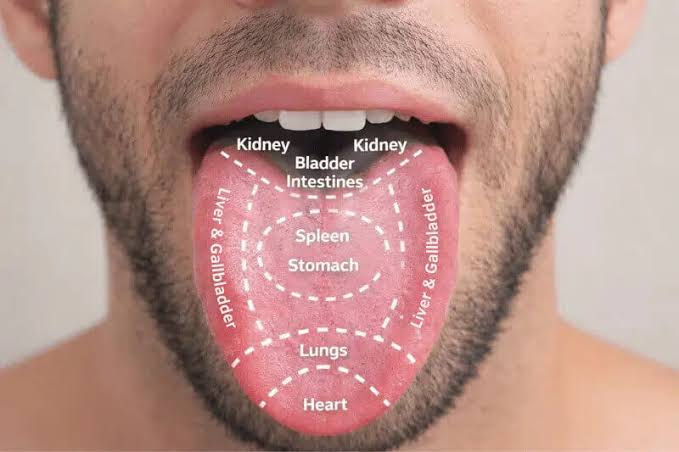
Look at the whole tongue: the tip, the sides (edges), the center, the back, and the underside if you can. Different areas correspond to different organ systems.
The tongue is divided into zones in TCM. The tip corresponds to the Heart and Lungs. The sides correspond to the Liver and Gallbladder. The center corresponds to the Spleen and Stomach. The back (near the throat) corresponds to the Kidney and Lower Burner.
What to Look For: A TCM Tongue Guide
Here are the most clinically significant things to observe, and what they mean:
Tongue Body Color
The body of the tongue, the actual flesh beneath any coating, is one of the most informative aspects of tongue diagnosis:
Tongue Sign | What It Looks Like | What It May Indicate |
Pale pink to light pink | Slightly lighter than normal | Qi or Blood deficiency: low energy, fatigue, feeling run down |
Healthy pink-red | Vibrant, even color | Generally balanced: this is the goal |
Red | Brighter than normal, vivid | Heat in the body: could be excess heat, yin deficiency, or inflammation |
Dark red / crimson | Deep, almost purple-red | Significant heat or fire: often seen with high fever or severe yin deficiency |
Purple | Bluish-purple, especially on sides | Blood stagnation: poor circulation, cold in the blood, or chronic pain patterns |
Pale purple / lavender | Slightly purplish and pale | Cold and blood stagnation together: common in chronic cold conditions |
Tongue Coating
The coating (sometimes called the "fur") sits on the surface of the tongue and is produced by the Stomach. A thin, white, evenly distributed coating is considered healthy and normal. Changes in the coating are significant:
Tongue Sign | What It Looks Like | What It May Indicate |
Thin white coat | Light, even distribution | Normal and healthy |
Thick white coat | Visibly thick, white-grey | Cold or damp accumulation: sluggish digestion, congestion |
Yellow coat | Pale to deep yellow | Heat: the thicker and darker the yellow, the more heat is present |
Thick yellow coat | Deep yellow, possibly brown | Significant heat, often with damp: common in digestive inflammation |
No coating (peeled) | Bare tongue, shiny or smooth | Stomach Yin deficiency: chronic depletion, often seen with dryness symptoms |
Geographic (patchy) | Irregular patches, like a map | Mixed patterns: areas of deficiency alongside retained pathogen |
Greasy or sticky coat | Feels thick and wet | Damp or phlegm accumulation: digestive congestion, foggy thinking |
Tongue Shape and Size
Tongue Sign | What It Looks Like | What It May Indicate |
Swollen or puffy | Wider than normal, may have teeth marks on edges | Spleen Qi deficiency with dampness: fluid retention, fatigue, bloating |
Teeth marks (scalloped) | Wavy indentations along edges | Spleen Qi deficiency: often goes with fatigue and poor digestion |
Thin / narrow | Narrower than normal, possibly shriveled | Yin or Blood deficiency: dryness, depletion |
Stiff or deviated | Doesn't extend straight, feels rigid | Wind or phlegm obstruction: requires prompt evaluation |
Trembling | Shakes when extended | Qi deficiency or internal Wind: important to note and discuss with practitioner |
Cracks and Markings
Tongue Sign | What It Looks Like | What It May Indicate |
Central crack | Line down the center from tip to back | Stomach Yin deficiency or constitutional Spleen weakness |
Tip cracks | Fine cracks at the tip | Heart fire or Heart Yin deficiency |
Transverse cracks | Horizontal lines across the body | Spleen Qi deficiency, often chronic |
Red dots or spots | Raised red points, especially at tip or sides | Heat: Blood heat, Heart fire, or Liver fire depending on location |
Putting It All Together
Tongue diagnosis is rarely about one isolated sign, it's about patterns. A pale tongue with a thin white coating and teeth marks paints a very different picture from a red tongue with a thick yellow coating and cracks at the tip. The art of tongue reading (and TCM diagnosis in general) is in seeing how the signs relate to each other and to the rest of what the patient reports.
That said, even a basic ability to read your own tongue can be remarkably useful. Many patients use it as a self-check between appointments: "My coating is getting thicker, I should probably watch what I'm eating," or "My tongue tip is redder than usual, I've been stressed and not sleeping well." It's a feedback tool that's always available, completely free, and remarkably informative once you know what you're looking at.
If you're curious about what your tongue says about your current health picture, bring it to your next appointment and ask us to walk you through it. Or if you haven't been in yet, your tongue is as good a reason as any to come say hello.
Book your acupuncture session today → Here


Comments